

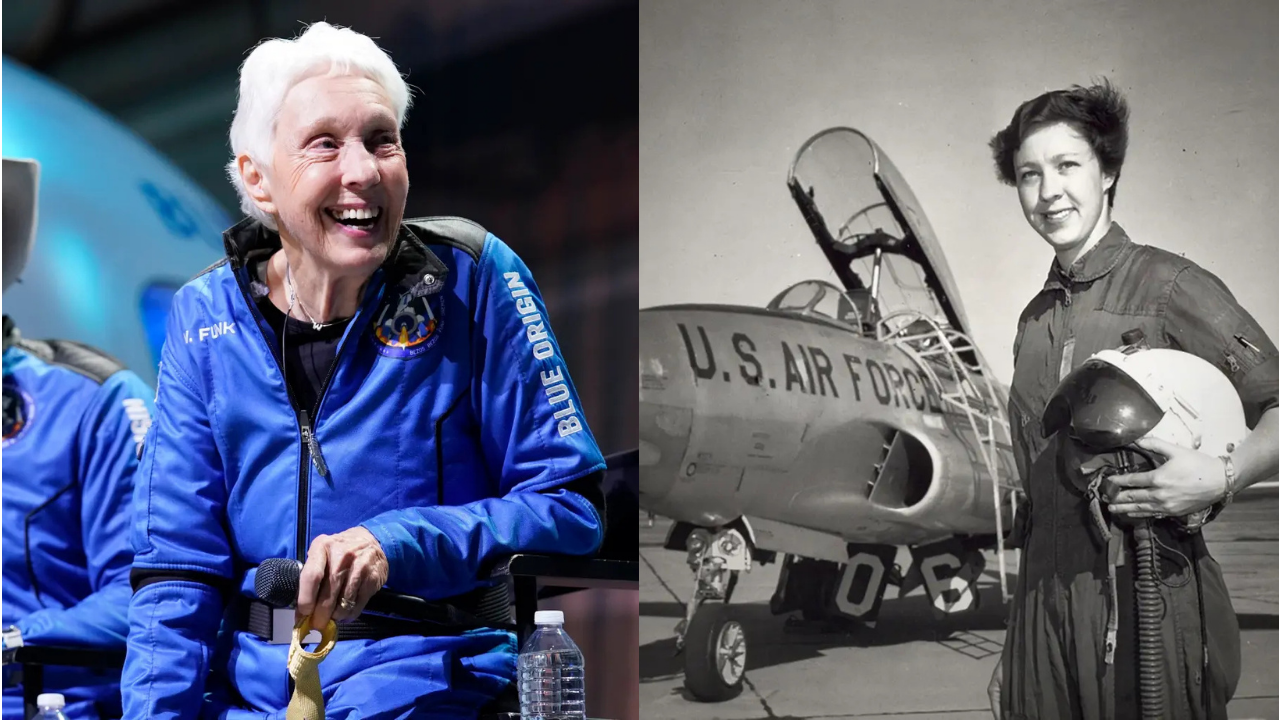
Wally Funk, the pioneering American aviator who became the oldest woman ever to travel into space, has died at the age of 87, closing the chapter on a remarkable life defined by perseverance, determination and a passion for flight.
Funk died on Wednesday at her assisted living residence in Grapevine, Texas. According to Grapevine City Council member Duff O’Dell, who also served as her caregiver, recent falls and a leg infection contributed to her declining health. O’Dell said she was with Funk during her final moments.
 Photo Credit: AP Photo/Tony Gutierrez
A Dream Delayed for Decades
Long before commercial space tourism became reality, Funk had already proven she belonged among America’s earliest astronaut candidates.
In the early 1960s, she was one of the 13 women later known as the Mercury 13, a privately funded group of highly skilled female pilots who successfully completed many of the same physical and psychological tests administered to NASA’s male astronauts. Despite demonstrating exceptional abilities, the women were never admitted into NASA’s astronaut program because women were excluded from spaceflight opportunities at the time.
Although her path to space was blocked, Funk never abandoned her ambition.
Finally Reaching Space at 82
Her lifelong dream was realized in July 2021 when Amazon founder Jeff Bezos invited her to join Blue Origin’s first crewed New Shepard mission as an honored guest.
At 82 years old, Funk became the oldest person to travel into space during the suborbital flight. While that overall age record was later surpassed by actor William Shatner and former astronaut candidate Ed Dwight, both at age 90, Funk remains the oldest woman ever to make the journey beyond Earth’s atmosphere.
Blue Origin paid tribute following news of her death, describing her as “a pioneer in every sense of the word” and saying the company was honored to help fulfill the dream she had pursued for more than six decades.
A Career Filled With Aviation Firsts
Funk’s influence extended well beyond her historic spaceflight.
She became the first female inspector for the Federal Aviation Administration and later the first female air safety investigator for the National Transportation Safety Board. Throughout her career, she also trained thousands of pilots and accumulated tens of thousands of flight hours, earning widespread respect throughout the aviation community.
Her achievements came during an era when women faced significant barriers in aviation, yet she continued to build a career marked by technical expertise, leadership and mentorship.
 Photo Credit: BLUE ORIGIN/AFP via Getty Images
Remembered for Optimism and Determination
Friends and colleagues frequently described Funk as someone whose enthusiasm never faded, even after decades of setbacks.
O’Dell said Funk refused to let repeated rejection discourage her, choosing instead to work harder each time she was told certain opportunities were unavailable to women. That resilience became one of the defining characteristics of her public legacy.
A Lasting Legacy
Although it took more than 60 years for her childhood dream of spaceflight to become reality, Funk’s journey became a powerful symbol of persistence and changing opportunities in aerospace.
Her story continues to resonate far beyond aviation, representing the determination to pursue long-held ambitions despite institutional barriers. From breaking gender barriers in government aviation roles to finally reaching space in her eighties, Wally Funk leaves behind a legacy that will remain an important part of both aviation and spaceflight history.