


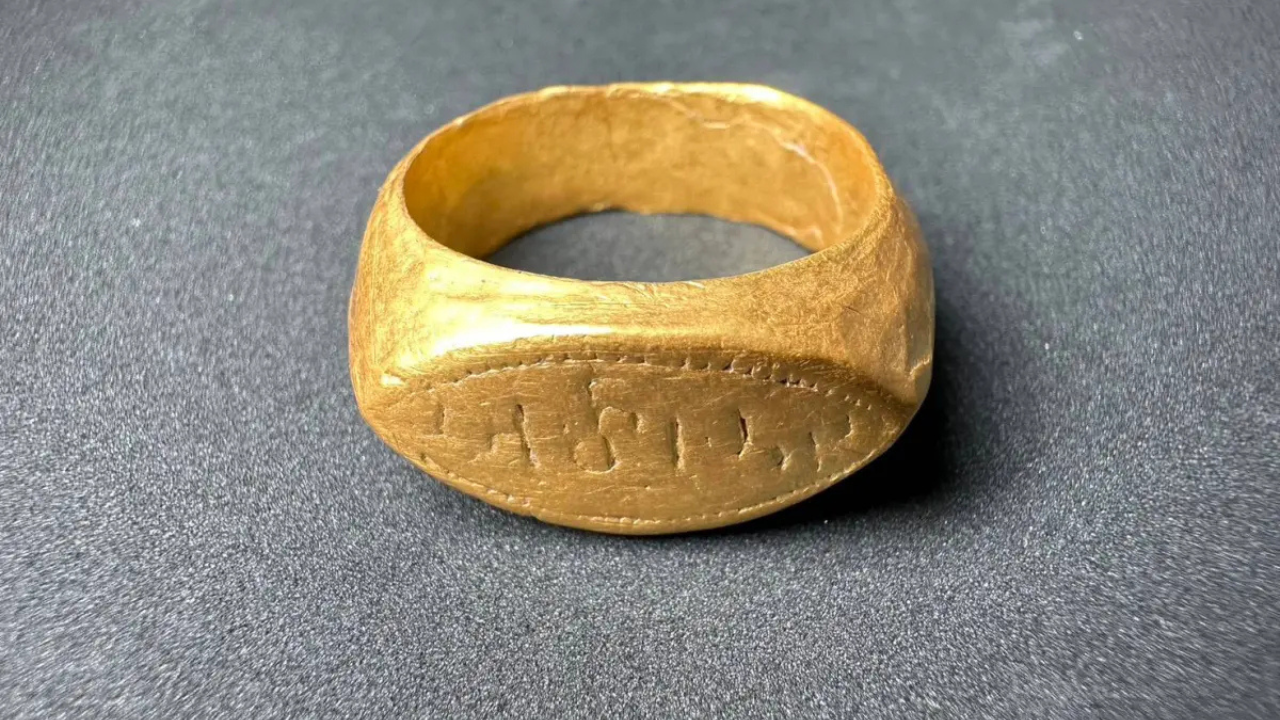
A pair of gold rings believed to be approximately 2,000 years old has been uncovered during archaeological excavations in western Thailand, providing new insights into the region’s ancient history and its connections with neighboring civilizations.
The discoveries were made at the Don Yai Thong archaeological site in Phetchaburi province, about 130 kilometers southwest of Bangkok. The rings were found alongside human skeletal remains during an ongoing excavation led by Thailand’s Fine Arts Department.
 Photo Credit: The Fine Arts Department via AP
One of the rings features an engraved inscription written in Brahmi, one of the oldest writing systems of ancient India. Specialists who conducted an initial examination interpreted the inscription as “pusarakhitasa,” a phrase meaning “the one protected by Pushya.” Pushya is regarded as one of the most favorable zodiac constellations in traditional Indian astronomy, suggesting cultural or religious influences that extended well beyond the Indian subcontinent.
The second ring is a plain gold band without decorative markings but was recovered from the same burial.
Clues to Ancient Trade and Identity
Researchers believe the jewelry may have belonged to a merchant connected to the ancient Indian Vaishya community, a social group historically associated with trade and commerce. While the identification remains an archaeological interpretation rather than a confirmed fact, the find adds to growing evidence that commercial and cultural exchanges linked South Asia with mainland Southeast Asia nearly two millennia ago.
Artifacts carrying Brahmi inscriptions have previously been found across parts of Southeast Asia, reflecting the movement of merchants, religious ideas, and writing traditions through expanding trade networks during the early centuries of the Common Era.
A Newly Discovered Iron Age Site
The Don Yai Thong site first drew the attention of archaeologists earlier this year after local residents uncovered fragments of ancient bronze drums in a rice field. The discovery prompted a systematic excavation that has since revealed an extensive burial ground dating to Thailand’s late prehistoric Iron Age, roughly 1,500 to 2,500 years ago.
Since excavations began in February, archaeologists have uncovered eight human skeletons along with gold and bronze ornaments, pottery, and other burial objects. The collection suggests the cemetery may have been reserved for individuals of high social standing or considerable wealth within the community.
Why the Discovery Matters
Although small in size, the two rings could provide valuable evidence about the movement of people, goods, and ideas across Asia during the Iron Age. The engraved inscription, in particular, offers researchers a rare opportunity to examine how writing systems and cultural traditions spread through trade rather than conquest.
 Photo Credit: The Fine Arts Department via AP
Archaeological discoveries of inscribed jewelry are especially important because they can reveal information about identity, belief systems, and social status that ordinary artifacts often cannot.
Excavation Continues
The Fine Arts Department expects fieldwork at Don Yai Thong to continue for several more weeks before the excavation concludes. Once conservation and analysis are complete, officials plan to place the newly recovered artifacts, including the gold rings, on public display, allowing visitors to learn more about one of Thailand’s newest and potentially most significant archaeological discoveries.