

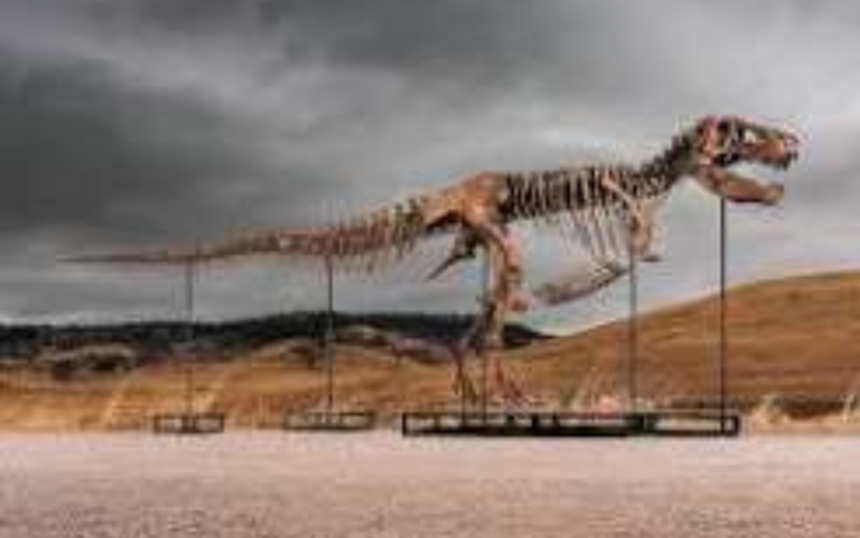
‘Gus’ Sets New Auction Record
A Tyrannosaurus rex fossil nicknamed “Gus” has rewritten the record books after selling for $50.1 million at a Sotheby’s auction in New York, making it the most expensive dinosaur fossil ever offered at auction. The winning bidder, who participated by telephone, has not been publicly identified.
The sale surpassed the previous auction record for a dinosaur fossil, set in 2024 when the Stegosaurus specimen known as “Apex” sold for nearly $45 million. It also exceeded the nearly $32 million paid for the famous T. rex skeleton “Stan” in 2020.

One of the Most Significant T. rex Discoveries
Discovered in South Dakota in 2021, Gus is estimated to be around 67 million years old. The specimen is regarded as one of the largest and most complete Tyrannosaurus rex skeletons ever found, preserving roughly 61% of its original fossilized bones, including an exceptionally well-preserved skull and several rare skeletal elements.
The mounted skeleton measures approximately 38 feet (11.6 meters) long and stands about 12.5 feet (3.8 meters) tall, offering an impressive glimpse into one of history’s most formidable predators.
Competitive Bidding Pushes Price Higher
According to Sotheby’s, bidding lasted around ten minutes and involved seven prospective buyers before the anonymous collector secured the fossil. The final sale price, which includes fees, significantly exceeded the auction house’s pre-sale estimate of $20 million to $30 million.
Following the sale, Sotheby’s highlighted the specimen’s scientific quality and careful preservation, describing it as an exceptionally documented and prepared fossil that appealed to collectors seeking museum-grade specimens.
Growing Market Raises Scientific Questions
The record-breaking sale reflects the growing demand for rare dinosaur fossils among private collectors and investors. While such auctions continue to attract global attention, they also fuel an ongoing debate within the scientific community over whether historically significant fossils should remain accessible to researchers and the public.
The Society of Vertebrate Paleontology has encouraged the new owner to place Gus on public display or make the specimen available for scientific study, arguing that fossils of this importance provide valuable opportunities for research and education.
What Happens Next
Sotheby’s has not disclosed the identity of the buyer or where the skeleton will ultimately be displayed. Whether Gus becomes part of a museum collection, is loaned for public exhibition, or remains in a private collection will likely determine how widely scientists and the public can access one of the most remarkable Tyrannosaurus rex fossils ever discovered.