


SpaceX entered public markets with unprecedented momentum, delivering the largest initial public offering in history and becoming one of the world’s most valuable listed companies within days of its debut. Investors rushed to buy shares when trading began on 12 June, sending the stock well above its IPO price and fueling optimism around Elon Musk’s expanding technology empire.
The rally proved short-lived. After reaching an early peak above $225 during its first week of trading, the stock steadily retreated through late June and early July. By the end of its first month as a publicly traded company, shares were trading around $145, leaving them well below their record high while still remaining above the original $135 IPO price.
Photo Credit: BBC
Investors reassess the company’s growth story
Much of the initial enthusiasm was tied to SpaceX’s growing involvement in artificial intelligence after integrating Musk’s AI business into the company and expanding its data-centre ambitions. That narrative helped attract investors looking for exposure to one of the market’s fastest-growing sectors.
As trading settled, investors increasingly shifted their attention to SpaceX’s existing businesses. While the company has ambitious AI plans, most of its current revenue continues to come from launch services and its Starlink satellite communications network. That change in focus has led some investors to place greater weight on current financial performance rather than future potential.
Market volatility weighs on the stock
The broader weakness across technology shares has also added pressure. Although SpaceX benefited from being included in major stock indices, including the Nasdaq-100, those milestones failed to reverse the downward trend.
Instead, the stock continued to fluctuate sharply as investors balanced optimism about the company’s long-term ambitions against concerns over its rich valuation and near-term profitability. On several trading days, SpaceX underperformed the wider market despite index inclusion that would typically support demand for its shares.
Recent trading has extended that decline even further. Shares briefly slipped below $140 on Monday, bringing them close to their IPO price and erasing hundreds of billions of dollars in market value from the company’s post-listing peak.
Early buyers face losses while IPO investors remain ahead
The stock’s retreat has created different outcomes for different groups of investors.
Those who received shares at the IPO price or held equity before the public listing continue to sit on gains. Investors who bought during the first few days of trading, when prices surged well above the offering price, have instead seen the value of their investments decline.
Market analysts have also pointed to unusually strong retail investor participation during the opening days of trading, suggesting that excitement surrounding Elon Musk and artificial intelligence contributed to a rapid rise that may have outpaced the company’s underlying fundamentals.
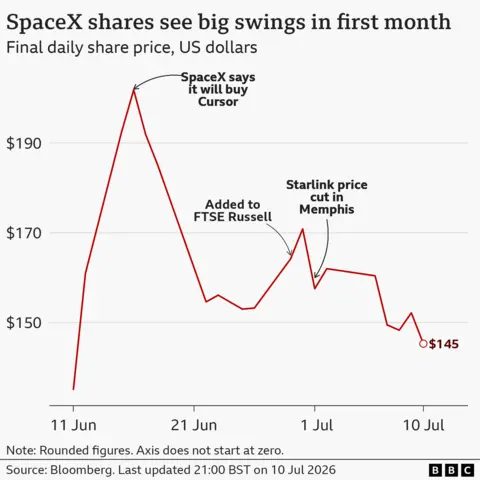
Photo Credit: BBC
Long-term optimism remains despite short-term pressure
Despite the recent pullback, several Wall Street firms continue to express confidence in SpaceX’s long-term prospects.
Analysts argue that the company’s combination of reusable rocket technology, Starlink’s expanding satellite network and future AI-related businesses could support significant growth over time. Some research firms have assigned price targets well above current trading levels, reflecting expectations that recent weakness may prove temporary rather than structural.
Elon Musk has also maintained an ambitious outlook, previously stating that SpaceX could eventually generate $1 trillion in annual revenue by 2030. At present, though, the company remains unprofitable, and public filings showed approximately $18 billion in revenue last year, highlighting the scale of growth required to reach those projections.
Earnings report could shape the next chapter
Investors are now looking beyond the IPO excitement toward the company’s first quarterly earnings report as a listed business, which analysts expect in early August.
The results are likely to provide the clearest indication yet of SpaceX’s financial health, revenue mix and future strategy. Around the same period, the expiration of the IPO lock-up period could allow employees and early investors to begin selling shares, potentially increasing market volatility if additional stock enters public trading.
A crucial test for the market’s biggest IPO
SpaceX’s first month on the stock market illustrates how quickly investor sentiment can change after a landmark public offering. Initial excitement pushed the company to extraordinary valuations, but attention has now turned to whether its financial performance can justify those expectations.
The coming earnings release and management’s outlook are expected to play a significant role in determining whether SpaceX can regain momentum or whether investors continue to take a more cautious view of one of the market’s most closely watched companies.