


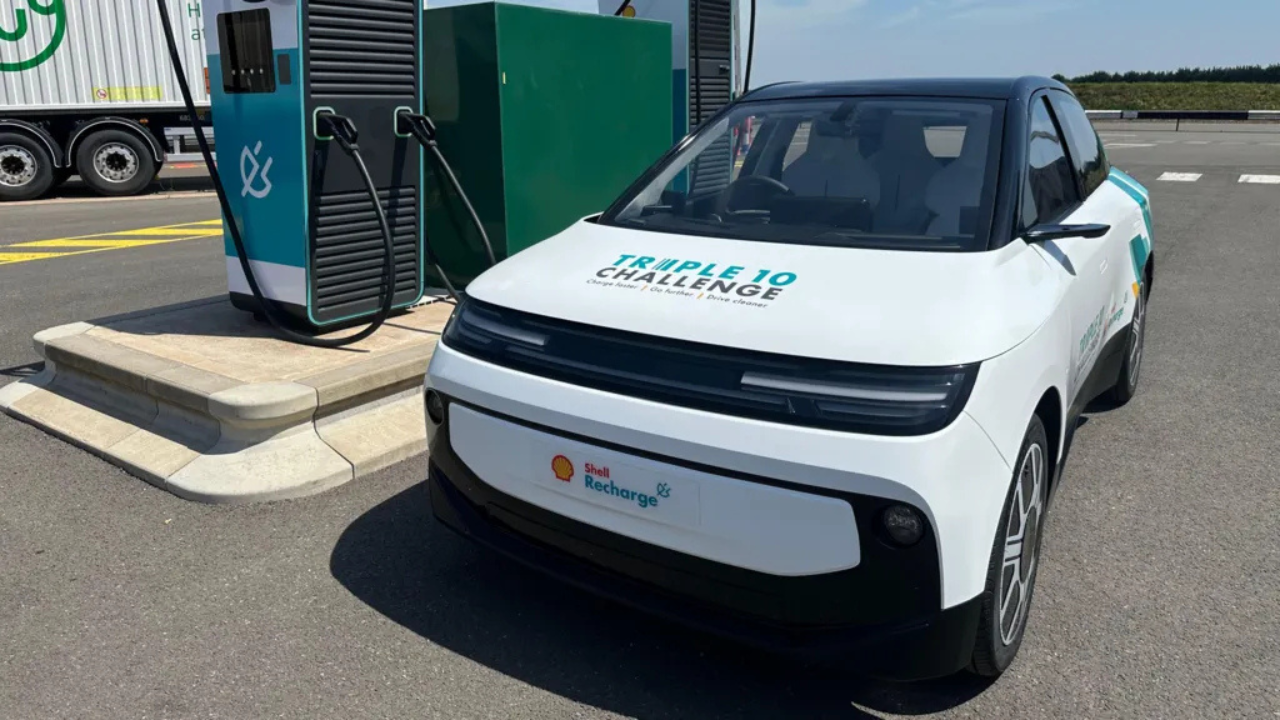
For years, electric vehicle development has largely focused on increasing battery size to extend driving range. Shell and a group of UK engineering partners are now proposing another path: build lighter, more efficient vehicles that charge faster without relying on ever-larger battery packs.
The result is the Shell Triple 10 Challenge Concept Car, an experimental vehicle unveiled at the HORIBA MIRA testing facility in Nuneaton, England. Rather than being designed for immediate production, the project serves as a technology demonstrator, bringing together advanced battery cooling, lightweight materials and improved energy efficiency in a single prototype.
Photo Credit: BBC
Built Around Three Ambitious Targets
The “Triple 10” name reflects the project’s three headline objectives: charging the battery from 10% to 80% in less than 10 minutes, achieving driving efficiency of 10 kilometres per kilowatt-hour, and reducing lifetime carbon emissions to approximately 10 tonnes of CO₂ equivalent.
According to Shell, the concept has achieved those engineering targets using technologies that already exist, although they have not yet been combined in a production vehicle. The company says the prototype completed its rapid charging test in 9 minutes and 54 seconds using a widely available 175kW fast charger rather than the ultra-high-power chargers some premium EVs require.
Immersion Cooling Sits at the Heart of the Design
One of the biggest innovations lies beneath the vehicle’s bodywork.
Instead of relying on a conventional cooling system, the battery cells, electric motor and power electronics are immersed in a specially developed dielectric thermal fluid. This immersion cooling system helps control heat more effectively during rapid charging and high-performance driving.
Engineers involved in the project say maintaining stable battery temperatures allows the cells to safely accept higher charging rates while remaining within operating limits. The simplified cooling architecture is also intended to reduce the number of components required, potentially lowering both weight and manufacturing complexity.

Photo Credit: Denis Gorman from RML Group explained how the battery was able to charge quickly
Smaller Battery Without Sacrificing Practicality
The concept also challenges another long-held assumption in the EV industry—that larger batteries are always better.
By improving efficiency and reducing vehicle weight, the development team says the prototype delivers around 200 kilometres (124 miles) of driving range despite using a battery roughly half the size expected for a vehicle in its class.
The vehicle incorporates recycled aluminium, recycled carbon fibre and other lightweight materials to reduce overall mass and lower lifecycle emissions. Together with the compact battery design, these measures aim to improve efficiency while reducing the environmental impact of manufacturing.
Testing New Technology Before Production
Developing an entirely new cooling approach presents engineering challenges beyond battery performance.
Researchers at HORIBA MIRA have been evaluating how the new thermal fluid interacts with components such as seals, hoses and other materials that must withstand years of vehicle use. Those tests are intended to determine whether the technology can meet the durability standards required for commercial production.
As with many early-stage prototypes, some components were built specifically for demonstration purposes. Reports from the test programme noted that the vehicle’s 3D-printed wing mirrors, for example, were not designed for prolonged exposure to extreme heat—an issue engineers say would not carry over to a production model.
Could Drivers See This Technology on the Road?
The Triple 10 Challenge Concept Car is not scheduled for sale, but Shell says interest from vehicle manufacturers has been encouraging.
The company believes the immersion cooling technology could appear in future generations of electric vehicles if development continues successfully. Collaborators on the project include RML Group, HORIBA MIRA and several other UK engineering firms, reflecting a wider industry effort to improve EV performance through smarter thermal management rather than simply increasing battery capacity.
Why the Project Matters
As automakers face pressure to reduce costs while improving charging speeds and efficiency, technologies that make smaller batteries more practical are attracting growing attention.
A lighter battery can reduce vehicle weight, lower material consumption and potentially make electric vehicles more affordable to build. If immersion cooling proves reliable at commercial scale, it could also simplify battery design while supporting faster charging on existing public charging infrastructure.
The Triple 10 Challenge remains a proof-of-concept rather than a production-ready vehicle, and further testing will be needed before its technologies reach consumers.
Even so, the project offers a glimpse of an alternative direction for electric vehicle development—one focused less on fitting ever-larger batteries and more on improving efficiency, thermal management and sustainable engineering. Whether that approach becomes mainstream will depend on how quickly manufacturers adopt and refine the technologies demonstrated in this prototype.