


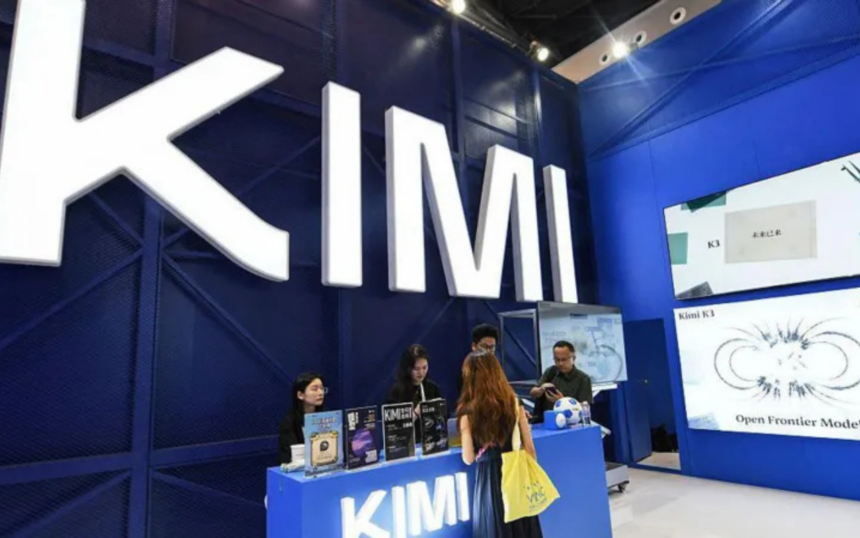
Chinese startup Moonshot AI has announced Kimi K3, a next-generation artificial intelligence model that the company says delivers performance comparable with the industry’s leading systems developed by OpenAI and Anthropic.
The unveiling took place during the World Artificial Intelligence Conference (WAIC) in Shanghai, where the company presented Kimi K3 as its most ambitious model to date. With 2.8 trillion parameters, it ranks among the largest AI models ever introduced and reflects China’s accelerating push to compete at the highest level of generative AI development.
Open-source release could broaden access
Moonshot AI plans to release Kimi K3 as an open-source model on July 27, allowing developers and businesses to download, customize and deploy the technology independently.
If released as announced, Kimi K3 would become the first freely available open-source AI model in the roughly three-trillion-parameter class. That approach differs from many of the most advanced AI systems from major U.S. companies, which generally remain proprietary.
The company says the model is designed for demanding tasks including software development, complex reasoning and knowledge-intensive work. Independent testing of its full capabilities is expected once developers gain access to the model.
A sign of China’s rapid AI progress
The launch highlights how quickly Chinese AI companies have advanced in recent years. Firms including Moonshot AI, Alibaba and other domestic developers have introduced increasingly capable large language models, challenging the perception that the United States maintains a wide technological lead.
Industry observers say the emergence of high-performance open-source models could increase competition by giving researchers, startups and enterprises broader access to cutting-edge AI without relying exclusively on closed commercial platforms.
Competition extends beyond performance
The latest announcement also reflects a broader shift in the AI industry, where competition is expanding beyond benchmark scores to include cost, accessibility and ecosystem development.
Open-source releases allow developers to adapt models for specialized applications, potentially accelerating innovation across software development, scientific research and enterprise services. At the same time, companies behind proprietary models continue to argue that keeping their most advanced systems closed offers greater security, reliability and control.
What comes next
Much of the attention will now turn to Kimi K3’s public release on July 27, when researchers and developers will be able to independently evaluate its coding, reasoning and knowledge capabilities.
Those real-world assessments will determine whether Moonshot AI’s performance claims hold up against leading models from OpenAI and Anthropic. Regardless of the outcome, Kimi K3’s arrival underscores the increasingly competitive nature of the global AI industry, with Chinese developers continuing to narrow the gap in advanced foundation models.