

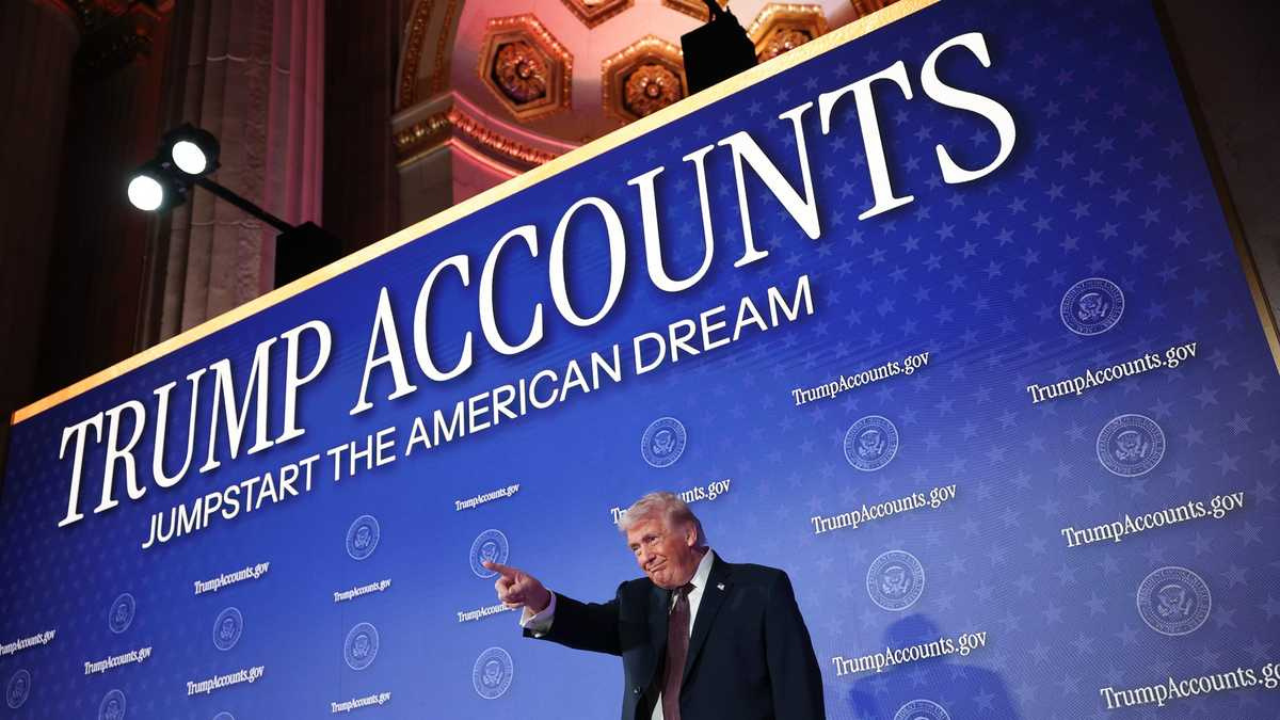
The Trump administration has launched Trump Accounts, a nationwide investment savings program intended to give children an early financial foothold by encouraging long-term investing. The initiative is available to children under 18 who have a valid Social Security number, while babies born between 2025 and 2028 are eligible for a one-time $1,000 contribution from the federal government to help start their accounts.
The rollout was marked by a high-profile ceremony celebrating the opening of financial markets, underscoring the administration’s effort to promote wider participation in stock market investing. Officials say the program is designed to increase access to wealth-building opportunities that have historically been concentrated among higher-income households.
 Photo Credit: Getty Images
How Trump Accounts Are Designed to Work
Parents can open an account through the program’s mobile app, with relatives, friends and certain employers allowed to contribute up to $5,000 each year for every child. The money must be invested in broadly diversified, low-cost U.S. stock index funds aimed at long-term growth rather than short-term trading.
The accounts are structured to encourage long-term saving. Funds grow without annual taxation while invested, but withdrawals are governed by rules similar to retirement accounts. Qualified uses include higher education, purchasing a first home and certain emergency expenses, while other early withdrawals may trigger taxes and penalties.
Unlike college-focused 529 plans or traditional retirement accounts, Trump Accounts combine elements of both, creating a new savings option specifically tied to children and long-term investing.
Supporters Say Early Investing Can Make a Difference
Backers of the initiative argue that beginning with an investment—even a relatively modest one—can introduce families to financial markets and harness decades of compound growth.
Program estimates suggest that the initial $1,000 contribution could grow substantially by the time a child reaches adulthood if investment returns resemble historical stock market performance, although officials emphasize those projections are not guaranteed. Additional annual contributions could significantly increase the eventual value of an account.
Large companies and financial institutions have also expressed support for the initiative. Investment firm BlackRock has highlighted the limited exposure many Americans have to financial markets, while companies including Visa and Dell have announced backing for the program. Michael and Susan Dell have separately pledged billions of dollars to provide additional seed funding for millions of eligible children outside the government’s newborn contribution.
Critics Question Who Will Benefit Most
Despite the optimistic message surrounding the launch, several tax and policy experts believe participation could be uneven.
Some argue that families with greater financial knowledge and disposable income are more likely to open accounts and make regular contributions, potentially widening existing wealth gaps rather than narrowing them. Others point to the program’s detailed eligibility requirements and withdrawal restrictions as obstacles that may discourage participation.
Policy analysts have also questioned whether lower-income families, whose children may need access to savings soon after reaching adulthood, will gain the same long-term advantages. If money is withdrawn for purposes outside the program’s qualifying uses, taxes and penalties could reduce its value. Several experts suggest that, depending on a family’s financial situation, existing education savings plans or brokerage accounts may remain more practical options.
Early Sign-Ups Show Interest, But Participation Remains Limited
Initial enrollment indicates interest in the new program, although participation remains well below the total number of eligible children.
Officials have said millions of accounts have been opened since the program became available, while hundreds of thousands of newborns have already received the federal $1,000 contribution. At the same time, tens of millions of children across the country remain eligible but have not yet enrolled.
Some parents have also reported delays in opening accounts for newborns because recently issued Social Security information has taken time to synchronize with federal systems. Treasury officials have described those issues as limited and temporary.
A Long-Term Test for a New Policy
Whether Trump Accounts ultimately reshape household wealth will likely take years to determine. The program’s success depends not only on government seed money but also on whether families continue contributing over time and whether children keep their investments growing into adulthood.
For supporters, the initiative represents an opportunity to introduce millions of young Americans to investing from an early age. Critics, meanwhile, argue that its real-world impact will depend on accessibility, financial education and whether lower-income families are able to benefit alongside wealthier households. As enrollment expands and participation data accumulates, the program’s effectiveness will become easier to measure.