


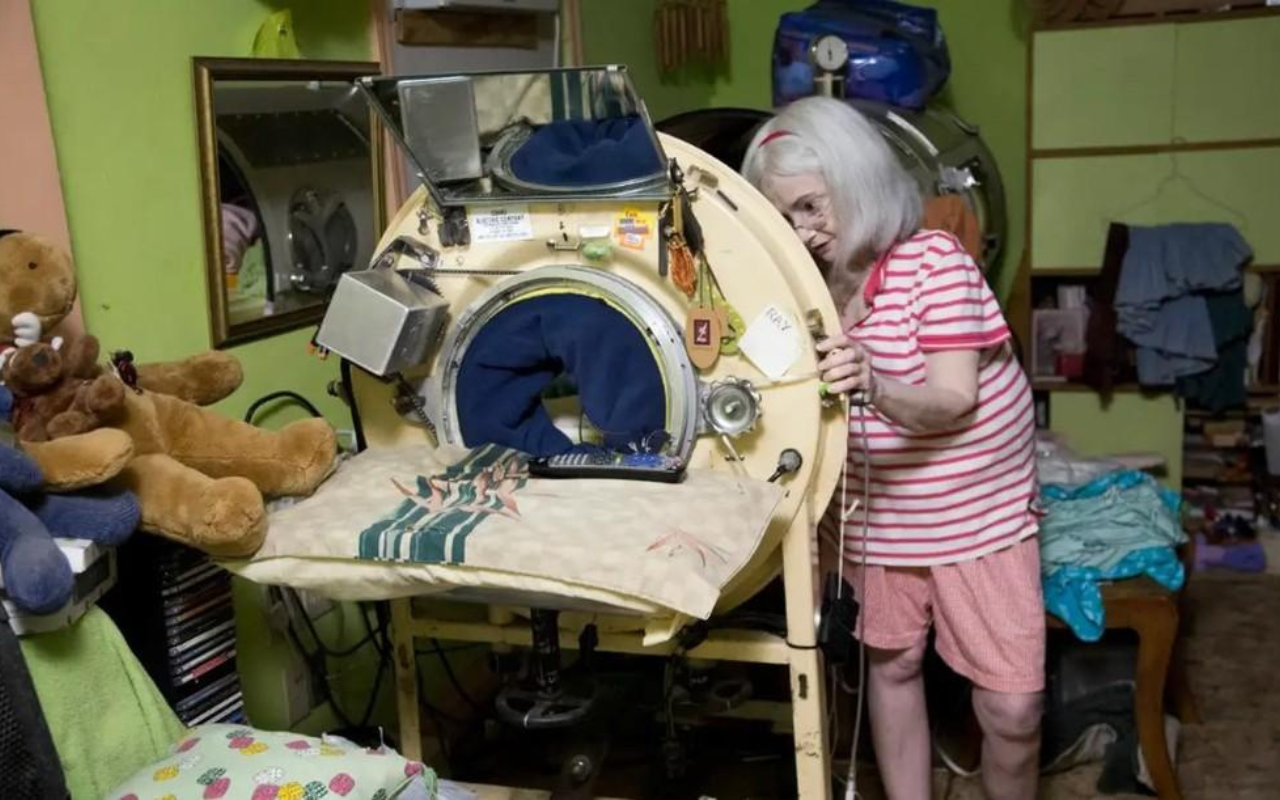
Martha Lillard spent much of her life depending on an iron lung to help her breathe, but those closest to her say the machine never defined who she was. Instead, they remember a woman whose determination, creativity and refusal to accept limits shaped every chapter of her life.
Believed to have been the last person in the United States still using an iron lung after surviving polio, Lillard became a symbol of resilience for those who knew her. Although the large metal cylinder was essential to her survival, her family says she focused on living rather than dwelling on the physical challenges she faced.

Refusing to Let Disability Set the Boundaries
Lillard contracted polio during an era when outbreaks left thousands of children and adults with paralysis or lifelong health complications. The disease affected her ability to breathe independently, requiring her to spend hours each day inside an iron lung, a mechanical ventilator that uses changes in air pressure to assist breathing.
For decades, the device remained an unavoidable part of her daily routine. Yet according to her younger sister, Cindy McVey, Lillard consistently found ways to adapt.
“She was resilient,” McVey said, recalling her sister’s determination to overcome obstacles rather than be defined by them. “She would find a way, or make do.”
That attitude extended well beyond her medical needs. Lillard learned to drive, pursued painting as a creative outlet and devoted herself to caring for her beloved beagles, embracing activities that reflected her independent spirit.
A Private Person with an Extraordinary Story
Despite the remarkable nature of her life, Lillard preferred to stay out of the spotlight. McVey said there are only a limited number of photographs showing her sister inside the iron lung because she disliked being photographed while lying in the machine.
Those who knew her say that preference reflected her desire to be seen for who she was rather than for the medical equipment she relied upon.
Family members remember her not as someone defined by illness, but as someone whose personality, interests and perseverance consistently took center stage.
A Reminder of the Polio Era
Iron lungs were once a common sight in hospitals during the height of the polio epidemics in the mid-20th century. The machines kept patients alive by mechanically assisting breathing when paralysis affected the muscles required for respiration.
As vaccines dramatically reduced polio cases around the world, the need for iron lungs steadily disappeared. Advances in modern ventilators also replaced the bulky devices that once lined hospital wards.
Lillard’s continued use of an iron lung served as a living reminder of a disease that shaped generations before widespread vaccination brought outbreaks under control.
A Legacy of Strength
For her family, Lillard’s legacy is measured less by the extraordinary circumstances of her survival than by the way she approached everyday life. They say she consistently chose determination over self-pity, finding purpose in her hobbies, her independence and the relationships she cherished.
Her story stands as a testament to the resilience of people who lived through the polio era and adapted to challenges that would have seemed insurmountable to many. While the iron lung sustained her breathing for decades, those closest to Martha Lillard believe it was her unwavering resolve that truly carried her through life.