


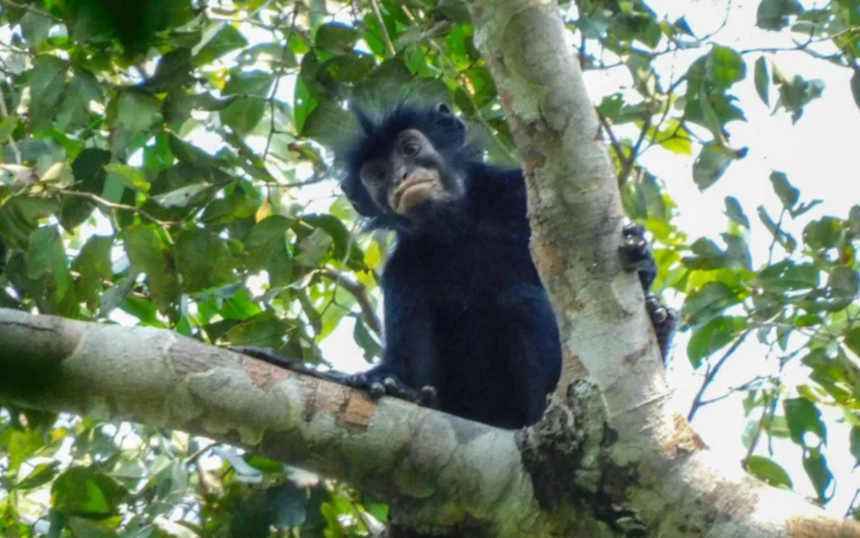
A distinctive black-furred monkey with striking pinkish-orange lips has been confirmed as a new species after years of scientific investigation in the Democratic Republic of Congo (DRC).
The newly identified primate, known locally as Likweli, lives high in the dense rainforest canopy of Lomami National Park in the country’s central-east. Researchers have formally named the species Colobus congoensis, making it only the fifth new African monkey species to be described by science in the past 75 years.
A Discovery Nearly Two Decades in the Making
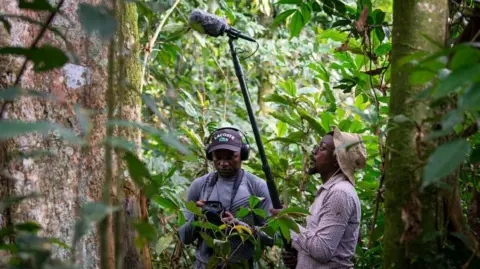 Photo Credit: Junior Amboko
The first clue that an unknown monkey might be living in the region came in 2008, when conservationists photographed an unusual animal during a field expedition. The image was too unclear to determine whether it represented a new species.
A second confirmed sighting in 2018 prompted researchers from the Democratic Republic of Congo and international institutions to launch an extensive field study. Over the following four years, the team documented more than 100 sightings across roughly 1,700 square kilometers of forest between the Lomami and Lilo rivers.
The repeated observations, combined with detailed physical examinations, vocalization analysis and genetic testing, confirmed that the monkey is distinct from all previously known colobus species.
Distinctive Appearance and Behavior
The newly described monkey stands out because of its vivid pinkish-orange lips, glossy black fur and dark facial markings. Researchers also identified unique vocalizations, including deep roaring calls with an acoustic pattern different from those of closely related colobus monkeys.
Field observations suggest the animals usually travel in small social groups and are often seen alongside other monkey species in the rainforest canopy. Like other colobus monkeys, they are primarily leaf-eaters and play an important role in maintaining healthy forest ecosystems.
Why the Discovery Matters
Finding a previously unknown species of African monkey is exceptionally rare. Africa’s primates have been extensively studied for decades, making discoveries of entirely new species increasingly uncommon.
The identification of Colobus congoensis also highlights how parts of the Congo Basin remain biologically underexplored despite being one of the world’s richest centers of biodiversity. Scientists say the discovery underscores the importance of continued wildlife surveys and conservation work in remote tropical forests.
Conservation Concerns Already Emerging
Although the species has now been formally described, researchers believe its future could be uncertain.
Its known range appears to be limited to a relatively small area within the DRC, and the forests it inhabits face ongoing pressure from habitat loss and hunting. Because of these threats, the research team has recommended that the species be considered for endangered status while further population assessments are carried out.
What Comes Next
Scientists hope the formal recognition of the Likweli will encourage additional research into its behavior, population size and ecological role. The discovery also provides fresh momentum for conservation efforts aimed at protecting the forests of Lomami National Park, where one of Africa’s newest known primate species has been quietly living out of sight for years.