

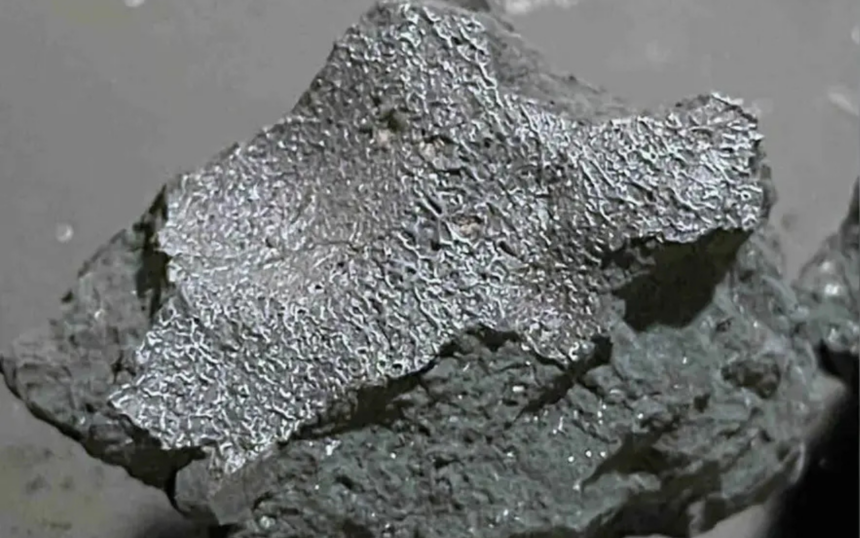
A meteorite that smashed through the roof of a home in Hillsborough, New Jersey, has become the focus of an important scientific discovery after researchers found evidence of unusual chemical processes unlike anything previously documented in its class of space rocks.
The object, now known as the Hillsborough meteorite, landed on July 16, 2024, after streaking across the northeastern United States in broad daylight. Scientists say the new findings reveal concentrated salt-rich fluids and a diverse collection of organic compounds preserved within the meteorite, providing a rare glimpse into the environment of a primitive asteroid billions of years ago.
A Rare Opportunity for Researchers
The meteor entered Earth’s atmosphere at roughly 32,000 miles per hour, producing a sonic boom that was heard across parts of the New York metropolitan area. Witnesses in several northeastern states reported seeing the fireball before it fragmented, scattering debris over portions of New Jersey and Staten Island.
One fragment weighing more than two pounds punched through the roof of a Hillsborough residence. Because the homeowner quickly recovered and carefully stored the meteorite, researchers were able to study an unusually pristine sample with minimal contamination. That level of preservation is considered exceptionally valuable for laboratory analysis.
Why Scientists Call It ‘Alien Chemistry’
The research team found evidence that the meteorite had once interacted with highly concentrated briny fluids near the surface of its parent asteroid. According to the study, this type of salt-rich alteration has not previously been identified in this rare class of carbon-rich meteorites.
Scientists also detected a range of carbon-bearing compounds, amino acids and other prebiotic molecules. While these substances are not evidence of extraterrestrial life, they are considered important ingredients that can participate in the chemistry leading to life. Their presence offers additional clues about how essential organic materials may have been transported throughout the early Solar System.
An Exceptionally Rare Space Rock
Researchers describe the Hillsborough meteorite as only the second observed fall of a rare CM1/2 carbonaceous chondrite, making it one of the most scientifically significant meteorites recovered in recent years.
Because the sample remained largely untouched after impact, scientists were able to examine delicate minerals and organic material that often degrade before recovery, providing a more complete record of the meteorite’s history.
Why the Discovery Matters
Meteorites act as natural archives from the earliest days of the Solar System, preserving materials that formed more than 4.5 billion years ago. By studying them, researchers hope to better understand the chemical environments that existed before planets fully formed.
The newly identified chemistry suggests that salty fluids may have played a greater role in producing or preserving life’s precursor molecules than previously recognized. While the findings do not indicate the discovery of alien organisms, they strengthen scientific understanding of the complex chemical pathways that may have contributed to life’s emergence on Earth.
What Comes Next
The research, published in Science Advances, is expected to guide future studies of carbon-rich asteroids and meteorites recovered on Earth. Scientists also plan to compare the Hillsborough sample with material collected during asteroid exploration missions to better understand how water, salts and organic compounds evolved in the early Solar System.