

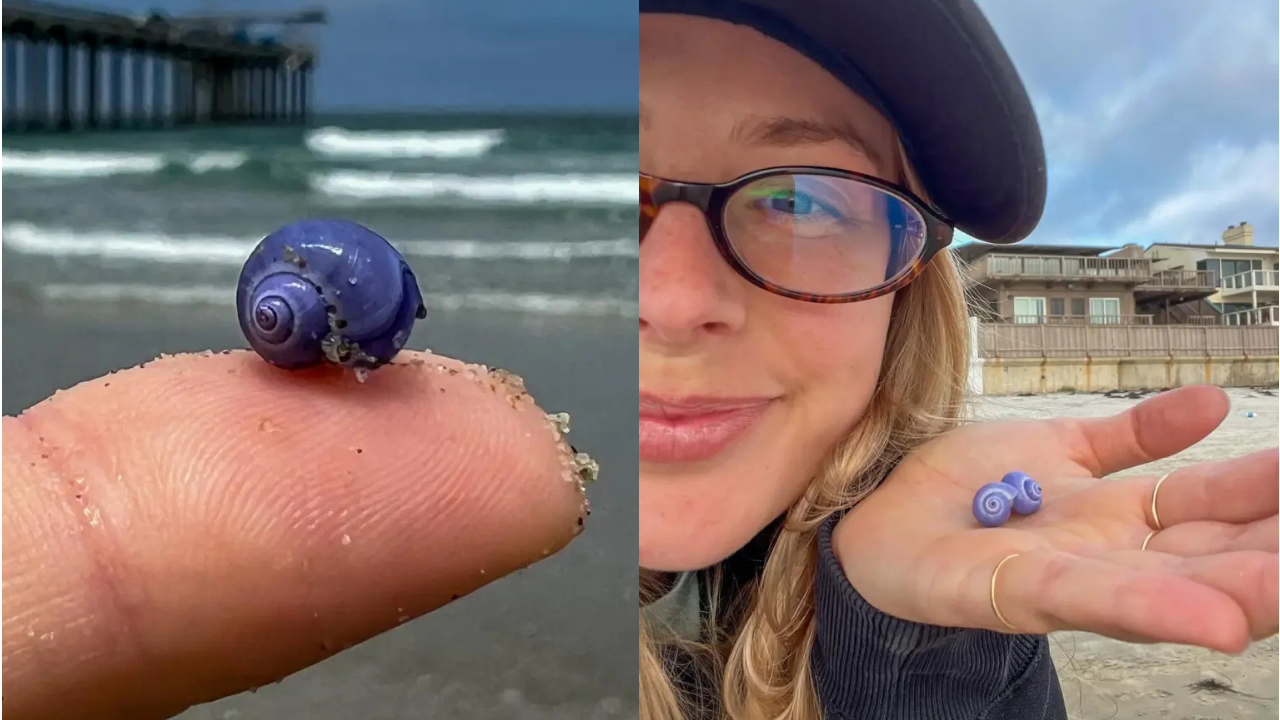
An evening walk along the shoreline in La Jolla led to an unexpected scientific find when a University of California San Diego doctoral student spotted the shell of a rare pelagic sea snail known as Janthina. The tiny shell, distinguished by its vivid purple color, is an uncommon sight on Southern California beaches and has drawn attention from marine researchers because of what its appearance may reveal about offshore ocean conditions.
An Unusual Find on the Beach
The shell was discovered by Anya Stajner, a Ph.D. student at the Scripps Institution of Oceanography. Recognizing the specimen immediately, she identified it as belonging to the Janthina genus, a group of ocean-dwelling snails that spend their lives floating at the sea’s surface rather than living on the seafloor.
 Photo Credit: Anya Stajner/Scripps Institution of Oceanography
According to the Scripps Institution of Oceanography, these snails remain afloat by creating a natural raft made from tiny air bubbles. This remarkable adaptation allows them to drift across the open ocean, where they are rarely seen by beachgoers unless changing ocean conditions carry them closer to land.
Why They Are Appearing Along the Coast
Marine scientists say Janthina species are generally associated with subtropical and tropical waters. Their occasional appearance along Southern California beaches is often linked to warmer offshore water masses moving toward the coastline, transporting floating marine life with them.
While such strandings are unusual, they are not considered unprecedented. Ocean currents and seasonal weather patterns can occasionally bring pelagic species ashore, offering researchers and the public a rare opportunity to observe animals that normally remain far from land.
Built for Life at the Ocean Surface
Janthina snails possess several distinctive features beyond their striking purple shells. Marine references describe their shells as having angled whorls and a slightly elongated apex.
Their coloration also serves a practical purpose. The snails use a form of camouflage called countershading, appearing darker on the side facing the sky and lighter underneath. This color pattern helps reduce their visibility to predators hunting from above, such as seabirds, as well as fish looking upward from below.
 Photo Credit: Anya Stajner/Scripps Institution of Oceanography
Adults can grow to roughly 1.5 inches (about 4 centimeters) in height. Although they are considered safe to handle, they are capable of releasing a purple ink-like secretion that may temporarily stain skin.
A Rare Glimpse Into Offshore Marine Life
Residents visiting La Jolla beaches do not typically encounter Janthina snails, making discoveries like this especially noteworthy. Local observers have expressed curiosity about why the species has become visible along the coast, reflecting growing public interest in how changing ocean conditions influence marine wildlife.
For scientists, each stranding provides another opportunity to document the distribution of pelagic species and better understand the environmental factors that bring these open-ocean organisms to shore.
Although the bright purple shells may capture attention for their appearance alone, they also offer a reminder of the complex relationship between ocean currents, seasonal water temperatures and the diverse marine life that inhabits the Pacific just beyond the coastline.