


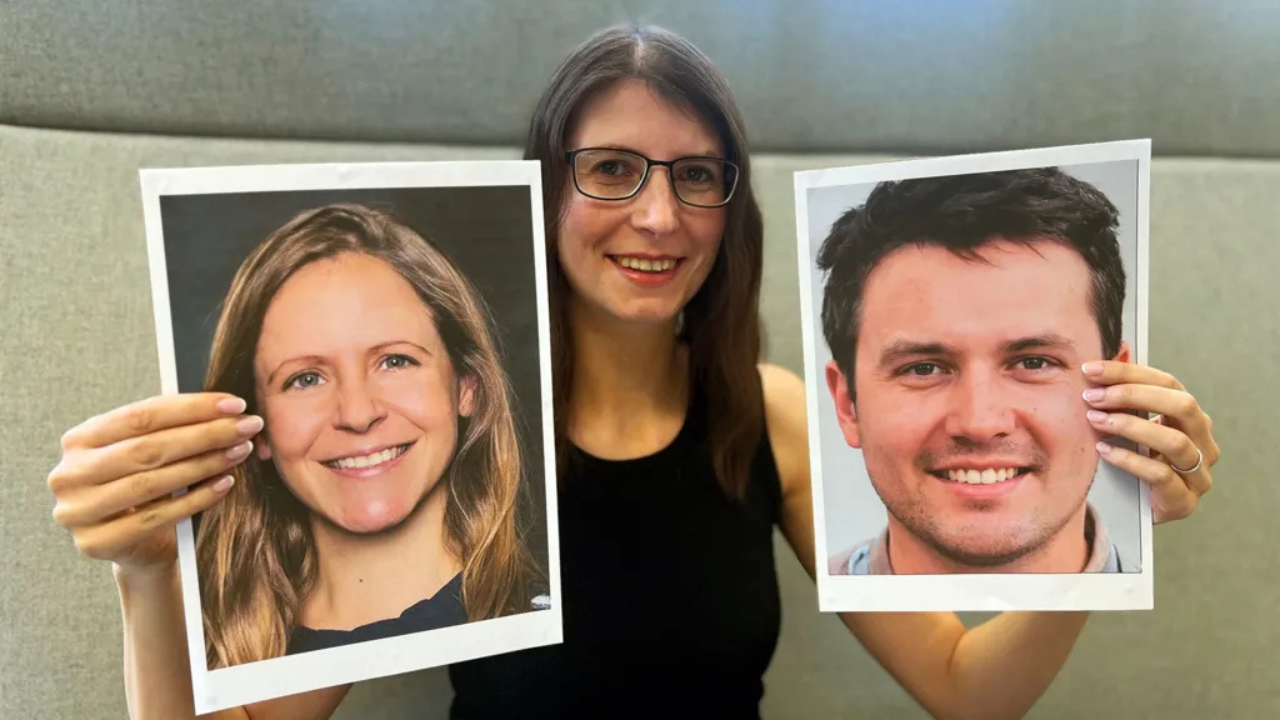
Artificial intelligence has reached a point where creating convincing human faces requires only a few clicks, making it increasingly difficult for the public to tell authentic images from digitally generated ones. The rapid improvement of image-generation technology has raised concerns about fraud, misinformation and identity deception across the internet.
A team of researchers from the University of Aberdeen, the Australian National University and partner institutions in Canada has been investigating whether people can be taught to recognize these increasingly sophisticated AI-generated faces. Their findings suggest that, despite AI’s rapid progress, training can still give people a meaningful advantage.
Photo Credit: BBC
Looking Beyond Obvious Mistakes
In the early days of AI image generation, fake pictures often contained glaring errors such as extra fingers, distorted facial features or mismatched accessories. Those visual giveaways have become much less common as newer AI models have improved.
Instead of searching for obvious flaws, researchers encourage people to pay attention to more subtle characteristics that often distinguish synthetic faces from real ones. These include unusually perfect facial symmetry, average-looking features, limited emotional expression and a lack of distinctive characteristics that make real people memorable.
The research also found that AI-generated faces frequently appear unusually attractive or highly polished, while real human faces naturally include small imperfections and unique traits. These differences are often difficult to describe individually but become easier to recognize with practice.
Training Improves Accuracy
To test whether these skills can be learned, researchers created thousands of AI-generated faces using the image-generation system StyleGAN3. Participants first attempted to identify which faces were genuine and which were AI-generated before receiving targeted training on the visual characteristics associated with synthetic images.
After the training session, participants showed substantial improvement. Researchers reported that average detection accuracy rose from roughly 40% before training to around 80% afterward, while some individuals approached near-perfect performance.
The study also addressed confidence levels. Earlier research suggested that people who believed they were especially good at spotting deepfakes often performed worse than expected. Following training, participants not only improved their accuracy but also became more appropriately confident in their judgments.

Photo Credit: Nightingale
Why Deepfake Detection Matters
The findings arrive as governments, businesses and cybersecurity experts warn about the growing misuse of AI-generated media. Deepfake images and videos have been used in online scams, identity fraud and misinformation campaigns, making it increasingly important for people to question what they encounter online.
One widely reported example involved fraudsters using AI-generated video technology to impersonate company executives during a video call, leading to a multimillion-dollar financial loss. Cases like this have intensified calls for stronger verification systems and greater public awareness.
Researchers say education will remain an important part of the response, even as AI continues to improve. They also point to complementary measures such as digital watermarking and stronger verification tools to help authenticate genuine content in the future.
The Challenge Continues
Although today’s AI-generated faces are more convincing than ever, researchers believe people are not powerless against the technology. Regular exposure to both authentic and synthetic images, combined with targeted training, can sharpen the ability to recognize subtle differences.
Even so, experts caution that deepfake detection remains a moving target. As AI systems continue learning from new data and producing increasingly lifelike content, the methods used to identify manipulated images will also need to evolve.