

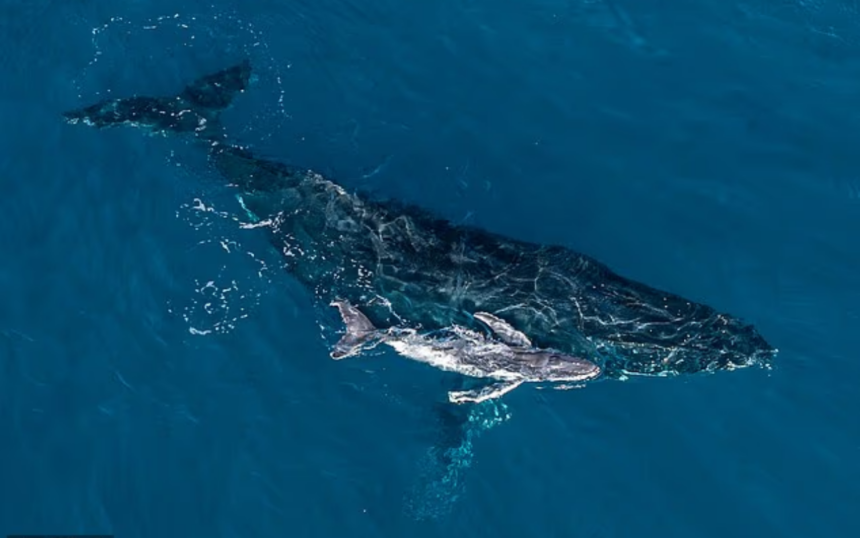
A routine whale monitoring mission off the New South Wales coast turned into an extraordinary scientific event when a drone recorded what researchers believe is the first aerial footage of a humpback whale giving birth.
The remarkable encounter took place while volunteers from the Organisation for the Rescue and Research of Cetaceans in Australia (ORRCA) were observing the annual northward migration of humpback whales. Drone pilot Alexander Forrest was filming from above when he noticed one female whale moving far more slowly than the rest of the migrating group.

An unexpected discovery
Forrest initially believed the whale had simply paused to rest because of its unusually slow and steady movement near the surface. Moments later, he saw a plume of blood beneath the animal before a newborn calf emerged and surfaced to take its first breath.
The mother remained close to the calf as it began its first movements through the water, with researchers observing the pair during the critical first moments after birth. Forrest later described the experience as something he never expected to witness during his years of filming whales.
A rare event for marine science
According to ORRCA, humpback whale births are exceptionally difficult to observe in the wild. The organisation’s head of research, Annie Post, said preliminary assessments suggest this is the first documented humpback whale birth ever captured by drone and only the fourth complete birth of the species recorded on film worldwide.
Researchers say the footage provides valuable behavioural observations, including the calf’s first breath, its earliest swimming movements and the mother’s immediate care after delivery. The organisation plans to analyse the video and accompanying field observations before submitting its findings for scientific publication.
Why the footage matters
Direct observations of whale births are extremely uncommon because humpbacks usually calve far from shore and spend little time at the surface during labour. Capturing the event from above offers scientists a unique perspective on maternal behaviour and newborn development that has rarely been available.
Marine researchers believe the recording could improve understanding of humpback reproduction and provide a valuable comparison with the small number of previously documented births.
Australia’s annual whale migration
Each winter, tens of thousands of humpback whales travel along Australia’s eastern coastline after leaving their Antarctic feeding grounds. They migrate north toward warmer tropical waters off Queensland and New South Wales, where breeding and calving occur before the whales begin the long journey south again.
The migration is considered one of the longest undertaken by any mammal, covering roughly 10,000 kilometres over the course of the round trip.
What happens next
Scientists will now review the footage in detail alongside observations collected during the encounter to better understand the birth sequence and the behaviour of both mother and calf. If confirmed through peer review, the recording will represent a significant addition to the limited scientific documentation of humpback whale births and may help inform future marine mammal research.