


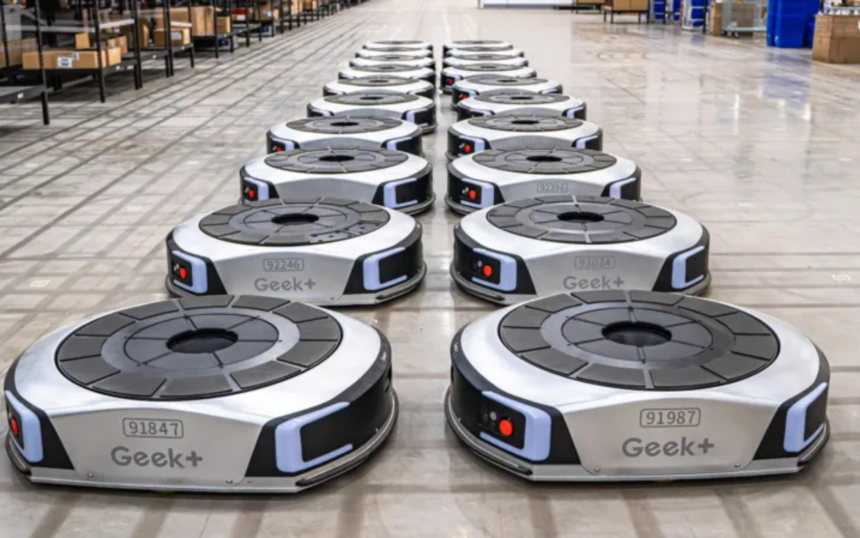
The rapid growth of e-commerce is reshaping how online orders are handled behind the scenes, with autonomous robots taking on more of the repetitive work inside British distribution centers.
Among the companies driving that shift is China’s Geek+, whose warehouse robots are now operating across multiple UK retail sites. The technology has been adopted by major retailers including Tesco, Asda and Next as businesses seek faster and more efficient ways to fulfill customer orders.
Rather than replacing every stage of warehouse work, the robots are designed to automate the movement of inventory. They travel beneath shelving units, lift entire storage racks, and transport them to employees who pick and pack customer purchases. By bringing products directly to workers instead of requiring staff to walk long distances through warehouses, retailers can speed up order processing while reducing physical strain on employees.
Built in China, deployed around the world
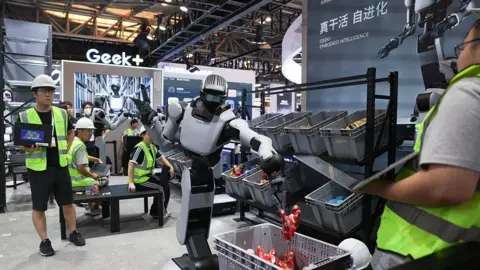 Photo Credit:Getty Images
The robots are manufactured at Geek+’s production facilities in Hefei, eastern China, where fleets of autonomous machines are assembled, tested and prepared for customers across international markets.
The company has grown into one of the world’s leading suppliers of autonomous mobile robots, serving retailers, logistics providers and manufacturers in numerous countries. Its expansion into Britain reflects the increasing role Chinese robotics firms are playing in global warehouse automation as retailers invest in technology to meet growing consumer expectations for faster deliveries.
Retailers seek greater efficiency
Warehouse automation has become a strategic priority as retailers face rising order volumes, labor shortages in some markets and pressure to improve productivity without significantly expanding warehouse space.
Geek+ says its systems allow businesses to store inventory more efficiently by making better use of shelving that may be difficult for workers to access quickly. The robots also help reduce picking mistakes and improve the speed at which orders move through fulfillment centers.
At Next, the company says a deployment of 250 autonomous mobile robots supports sorting and picking operations while enabling the retailer to process more than 16,000 products a day and maintain same-day fulfillment during busy trading periods.
Automation already delivering results
Asda has also integrated Geek+ technology into its logistics network. One of its national sortation projects introduced autonomous robots capable of sorting up to 2,000 parcels per hour while achieving very high accuracy, helping the retailer manage growing parcel and returns volumes without expanding its existing facility.
These systems are designed to work alongside warehouse employees rather than operate independently, with robots handling repetitive transportation tasks while staff focus on picking, packing and overseeing operations.
Why automation is becoming more important
Online shopping continues to place greater demands on supply chains, especially during seasonal peaks when retailers must process thousands of additional orders every day.
Autonomous warehouse robots offer companies a way to increase throughput, improve inventory management and respond more quickly to changing demand without relying solely on larger workforces or new warehouse construction. As artificial intelligence and robotics technology continue to advance, investment in automated fulfillment systems is expected to remain a major focus for retailers looking to improve operational efficiency.
What comes next
The wider adoption of warehouse robotics suggests automation will become an increasingly common feature of retail logistics in the years ahead. While human workers continue to play a central role in fulfillment operations, companies are steadily expanding the use of autonomous systems to handle routine tasks that can improve speed, accuracy and productivity.
For UK retailers competing in an increasingly fast-moving e-commerce market, the combination of human expertise and robotic automation is likely to remain a key part of future warehouse operations.